Divine Mercy Sunday is celebrated the Sunday following Easter. This year, Blessed John Paul II will be canonized on Divine Mercy Sunday.
Three years ago on May 1, 2011 Pope John Paul II was beatified and I attended my first Divine Mercy Service. In my journal in front of the Blessed Sacrament I wrote the following.
“Totus Tutus. All yours. I am ready to bear fruit in your Holy name. I offer this to the souls of…Above all I offer it to you Lord for without your love and mercy I would be forever lost. Lord I love thee, help me to love others.”
Prior to attending this service I was only familiar with the Divine Mercy Chaplet. I learned of the Divine Mercy Novena days after it began. Oh how I wished I had learned of it earlier. It would be another year before I could participate in this Novena. There are very special graces attached to this Novena provided that you are in a state of grace and loving others as Jesus loved. Here are some facts about Divine Mercy and a link to the chaplet. You can pray the chaplet anywhere anytime. This year I will be leading the Novena in the St. Malachy Blessed Sacrament Chaplet on Green Street in Brownsburg if you would like to attend.
Good Friday at 5pm and the 8 consecutive days following at 3pm, the hour of great mercy.
If you choose to pray the Novena this year I would ask that you pray that God’s will be done for dear Will Copeland. Will is a very talented young artist that I have had the pleasure of teaching for 5 years. He has been undergoing chemotherapy for a spinal astrocytoma since last summer. If you would like to support Will in the relay for life please click here. Hope for Cope
Divine Mercy ChapletDivine Mercy Novena
The Great Mercy Pope
Pope John Paul II, both in his teaching and personal life, strove to live and teach the message of Divine Mercy. As the great Mercy Pope, he wrote an encyclical on Divine Mercy:
“The Message of Divine Mercy has always been near and dear to me… which I took with me to the See of Peter and which it in a sense forms the image of this Pontificate.”
In his writings and homilies, he has described Divine Mercy as the answer to the world’s problems and the message of the third millennium. He beatified and canonized Sr. Maria Faustina Kowalska, the nun associated with the message, and he did it in Rome and not in Poland to underscore that Divine Mercy is for the whole world.
Establishing Divine Mercy Sunday for the Entire Church
When Pope John Paul canonized Sr. Faustina (making her St. Faustina), he also, on the same day, surprised the entire world by establishing Divine Mercy Sunday (the feast day associated with the message) as a feast day for the entire Church. The feast day falls on the Second Sunday of the Easter season. On that day, Pope John Paul II declared, “This is the happiest day of my life.”
Entrusting the World to Divine Mercy
In 2002, the Pope entrusted the whole world to Divine Mercy when he consecrated the International Shrine of The Divine Mercy in Lagiewniki, a suburb of Krakow in Poland. This is where St. Faustina’s mortal remains are entombed. The saint lived in a convent nearby. The Pope himself remembers as a young man working in the Solvay Quarry, just a few meters from the present-day Shrine. He also says that he had been thinking about Sr. Faustina for a long time when he wrote his encyclical on Divine Mercy. Further, the Holy Father has frequently quoted from the Diary of St. Faustina and has prayed The Chaplet of The Divine Mercy at the saint’s tomb.
Beyond the Life of John Paul II
Given all these connections to Divine Mercy and St. Faustina, is it any wonder that Pope John Paul II died on the Vigil of Divine Mercy Sunday (the evening before the feast day), which fell that year on April 3. It is also no surprise that the Great Mercy Pope left us a message for Divine Mercy Sunday, which was read on the feast day by a Vatican official to the faithful in St. Peter’s after a Mass that had been celebrated for the repose of the soul of the Pope.
Repeatedly Pope John Paul II has written and spoken about the need for us to turn to the mercy of God as the answer to the specific problems of our times. He has placed a strong and significant focus on the Divine Mercy message and devotion throughout his pontificate that will carry the Church long after his death.
via The Divine Mercy Message from the Marians of the Immaculate Conception.
Saint Maria Faustina Kowalska
The Mission of St. Faustina
The mission of St. Faustina was recorded in her Diary which she kept at the specific request of the Lord Jesus and her confessors. In it, she recorded faithfully all of the Lord Jesus’ wishes and also described the encounters between her soul and Him.
“Secretary of My most profound mystery,” the Lord Jesus said to Sr. Faustina, “know that your task is to write down everything that I make known to you about My mercy, for the benefit of those who by reading these things will be comforted in their souls and will have the courage to approach Me.” (Diary 1693)
Task One
Reminding the world of the truth of our faith revealed in the Holy Scripture about the merciful love of God toward every human being.
Task Two
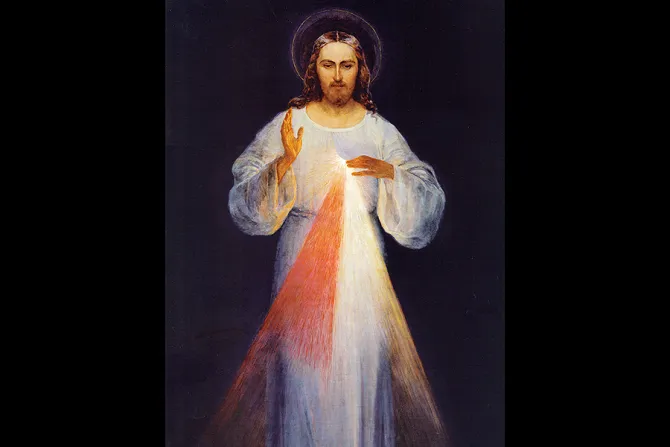
Entreating God’s mercy for the whole world and particularly for sinners, among others through the practice of new forms of devotion to the Divine Mercy presented by the Lord Jesus, such as: the veneration of the image of the Divine Mercy with the inscription: “Jesus, I Trust in You,” the feast of the Divine Mercy celebrated on the first Sunday after Easter, chaplet to the Divine Mercy and prayer at the Hour of Mercy (3 pm). The Lord Jesus attached great promises to the above forms of devotion, provided one entrusted one’s life to God and practiced active love of one’s neighbor.
Task Three
The third task in Sr. Mary Faustina’s mission consists in initiating the apostolic movement of the Divine Mercy which undertakes the task of proclaiming and entreating God’s mercy for the world and strives for Christian perfection, following the precepts laid down by the Blessed Sr. Mary Faustina. The precepts in question require the faithful to display an attitude of child-like trust in God which expresses itself in fulfilling His will, as well as in the attitude of mercy toward one’s neighbors. Today, this movement within the Church involves millions of people throughout the world; it comprises religious congregations, lay institutes, religious, brotherhoods, associations, various communities of apostles of the Divine Mercy, as well as individual people who take up the tasks which the Lord Jesus communicated to them through Sr. Mary Faustina.
via The Divine Mercy Message from the Marians of the Immaculate Conception.
Forms of Devotion
Through St. Faustina, the Merciful Savior has given the aching world new channels for the outpouring of His grace. These new channels include the Image of The Divine Mercy, the Feast of Mercy (Divine Mercy Sunday), the Chaplet, the Novena to The Divine Mercy, and prayer at 3 o’clock in the afternoon, the Hour of Great Mercy.
Although these means of receiving God’s mercy are new in form, they all proclaim the timeless message of God’s merciful love. They also draw us back to the great Sacrament of Mercy, the Holy Eucharist, where the living Lord, who suffered and died on the Cross and whose Heart was pierced with a lance, pours forth His mercy on all mankind, and grants pardon to all who draw near and honor Him. As Jesus told St. Faustina:
My Heart overflows with great mercy for souls, and especially for poor sinners…[I]t is for them that the Blood and Water flowed from My Heart as from a fount overflowing with mercy. For them I dwell in the tabernacle as King of Mercy. (Diary, 367)
via The Divine Mercy Message from the Marians of the Immaculate Conception.